Answer Engine Optimization (AEO): Complete Guide
Search is changing, and businesses need to rethink how customers discover their products, services, and information online.
For years, Search Engine Optimization (SEO) has helped websites attract visitors through traditional search engines such as Google and Bing. Businesses invested in keyword research, backlinks, technical optimization, and high-quality content to improve their positions in search results.
Today, the search experience is becoming more conversational.
Instead of searching for a keyword and browsing several websites, people increasingly ask detailed questions through AI-powered platforms such as ChatGPT, Google Gemini, Perplexity, and Google’s AI-powered search experiences.
These systems can provide direct answers, summarize information from multiple sources, and recommend products or services without requiring users to visit every website individually.
This shift has introduced an increasingly important digital marketing practice called Answer Engine Optimization (AEO).
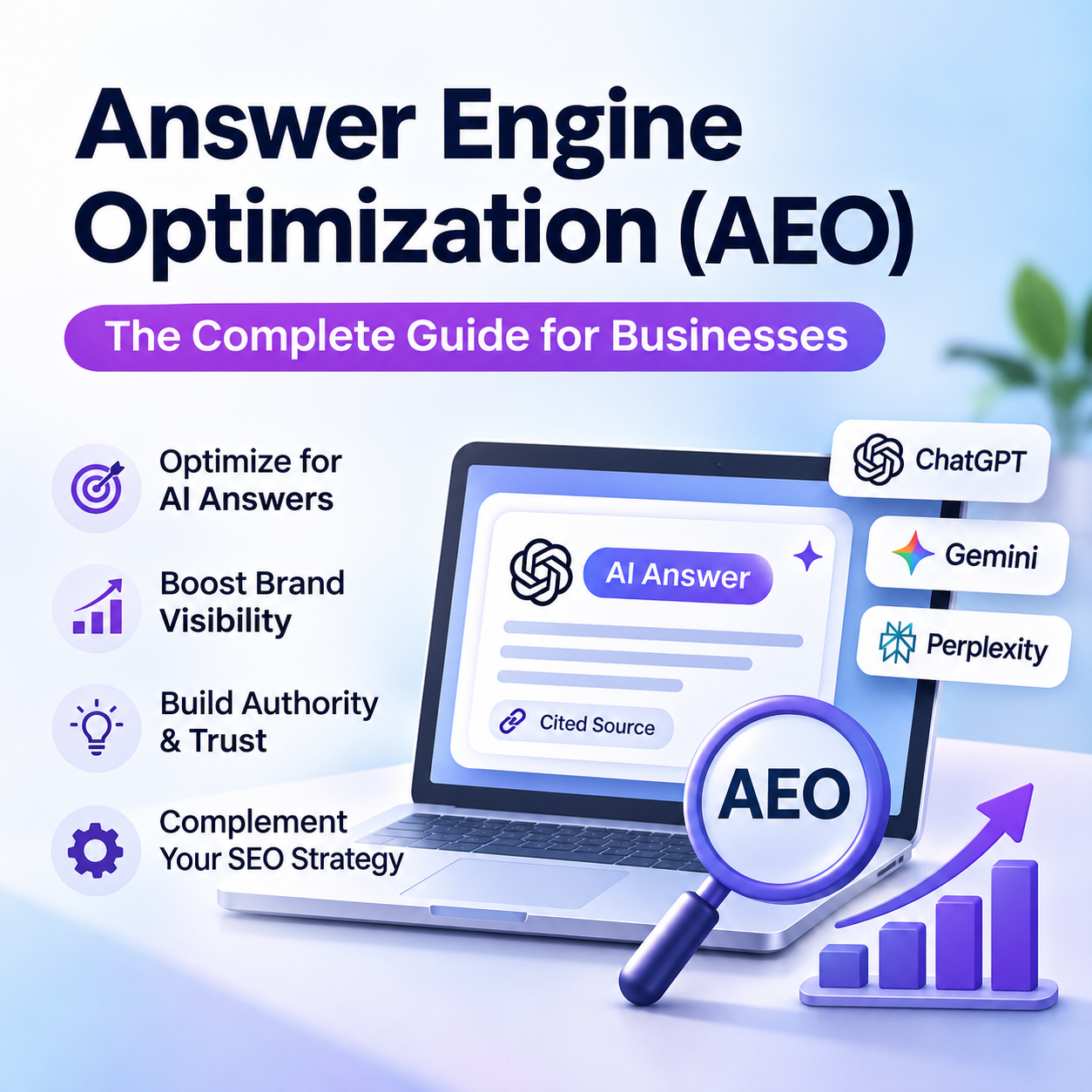
AEO focuses on making website content easier for AI-powered answer engines to discover, understand, evaluate, and reference when generating responses.
For businesses, this creates both an opportunity and a challenge. A website might perform well in traditional search results but receive limited visibility in AI-generated answers. Similarly, a brand might be mentioned by an AI assistant even when its website does not rank first for a particular keyword.
Understanding how AEO works can help businesses adapt their content strategies, strengthen their digital presence, and reach customers across emerging search experiences.
This guide explains Answer Engine Optimization, its relationship with SEO and Generative Engine Optimization, and practical techniques businesses can use to improve their visibility in AI-powered search.
What Is Answer Engine Optimization (AEO)?
Answer Engine Optimization (AEO) is the process of improving digital content so that AI-powered answer engines and search platforms can easily find, interpret, and use it when responding to user questions.
Traditional SEO primarily focuses on improving a website’s visibility in search engine results. AEO extends this approach by making information useful for systems that generate direct answers.
For example, consider someone searching for:
What is the best digital marketing strategy for a small business?
A traditional search engine may display articles, agency websites, and marketing guides.
An AI-powered answer engine may instead generate a summarized response covering SEO, social media marketing, paid advertising, and email marketing. Depending on the platform, it may also cite relevant websites.
If your website provides clear explanations, credible information, and useful examples, it may become a source that an answer engine references.
The objective of AEO is not simply to increase website traffic. It is also to improve brand visibility, credibility, and discoverability within AI-generated responses.
However, AEO does not guarantee that an AI platform will mention or cite a particular website.
How Does Answer Engine Optimization Work?
Answer Engine Optimization works by improving the accessibility, structure, relevance, and credibility of online information.
AI-powered answer engines use different technologies to generate responses. Some rely on information learned during model training, while others retrieve current information from websites, search indexes, or connected sources.
When a user submits a question, an answer engine may interpret the user’s intent, retrieve relevant information, compare available sources, and generate a response.
AEO helps websites participate more effectively in this process.
For example, a website publishing an article about employee transportation costs might explain:
- What employee transportation services include.
- How companies calculate transportation expenses.
- Which factors increase operational costs.
- How route optimization reduces unnecessary travel.
- What businesses should consider when choosing transportation providers.
When these topics are explained clearly, the content becomes easier for search systems to interpret and potentially retrieve.
Effective AEO therefore combines traditional SEO, structured content, technical accessibility, factual accuracy, and strong brand credibility.
Why Is Answer Engine Optimization Important for Businesses?
Answer Engine Optimization is becoming important because customers are discovering information through more channels than traditional search engines.
A potential customer researching business software may ask ChatGPT to compare solutions. Someone planning a holiday may use an AI assistant to identify destinations. A marketing manager may ask Perplexity to recommend digital marketing tools.
These interactions can influence purchasing decisions before customers visit a company’s website.
Businesses that ignore AI search may miss opportunities to appear during the research and comparison stages of the customer journey.
AEO can support several business objectives.
First, it can increase the chances of brand discovery when customers ask relevant questions.
Second, it encourages businesses to publish clearer and more helpful content.
Third, it supports brand authority by emphasizing expertise, accurate information, and credible references.
Finally, it creates additional opportunities to attract visitors from AI platforms that provide source links.
AEO should be viewed as an extension of digital marketing rather than a replacement for existing SEO activities.
What Is the Difference Between AEO, SEO, GEO, and LLMO?
Although these terms are closely related, they describe slightly different approaches to online visibility.
| Strategy | Primary focus |
|---|---|
| SEO | Improving visibility in traditional search results |
| AEO | Making content suitable for direct answers |
| GEO | Improving visibility in generative AI responses |
| LLMO | Improving how large language models understand and represent information |
Search Engine Optimization focuses on technical performance, keyword relevance, content quality, internal linking, and backlinks.
Answer Engine Optimization emphasizes clear answers, question-based content, structured information, and relevance to conversational queries.
Generative Engine Optimization (GEO) focuses more broadly on visibility within AI-generated responses, including citations, references, and brand mentions.
Large Language Model Optimization (LLMO) concerns how information about a brand, product, or subject is represented and retrieved by language-model-based systems.
In practice, these disciplines overlap considerably, and their definitions are not universally standardized.
A business does not necessarily need four separate optimization programs. A coordinated strategy built around useful content, technical SEO, credibility, and measurable AI visibility can support all four.
How Are AI-Powered Answer Engines Changing Traditional Search?
Traditional search often involves entering a keyword, reviewing results, and visiting websites to gather information.
AI-powered search can shorten this journey by presenting summarized answers directly.
For example, a user searching for corporate transportation services may receive a list of websites.
However, asking an AI assistant How can a company reduce employee transportation costs without compromising safety? may produce a detailed explanation with recommendations.
This changes how businesses should approach content creation.
Instead of optimizing only for short keywords, websites should address complete questions, specific problems, and decision-making scenarios.
Search is also becoming more conversational. Users can ask follow-up questions, request comparisons, and refine their requirements without starting a new search.
Businesses should therefore develop content that addresses the entire customer journey, from basic awareness to detailed product or service evaluation.
Traditional search remains important, but AI-generated answers are creating another layer of online discovery.
What Are the Key Benefits and Challenges of Answer Engine Optimization?
AEO offers several potential advantages for businesses investing in digital visibility.
One major benefit is the opportunity to reach customers through AI-powered discovery platforms. A useful article may be referenced when an answer engine responds to a relevant question.
Another benefit is improved content quality. AEO encourages businesses to organize information logically, answer questions directly, and provide supporting evidence.
It can also strengthen brand positioning. When a company consistently publishes reliable industry information, customers may begin to recognize it as a knowledgeable source.
However, AEO presents challenges.
AI-generated responses may not always include website citations. Different platforms may recommend different sources, and responses can change depending on how questions are phrased.
AI assistants may also summarize information inaccurately or use outdated details.
Measuring AEO performance is more complicated than tracking traditional keyword rankings because there is no single universal ranking position across AI platforms.
Businesses should approach AEO as a long-term visibility strategy rather than expecting immediate results.
How to Develop an Effective Answer Engine Optimization Strategy?
An effective Answer Engine Optimization Strategy begins with understanding what customers want to know.
Businesses should identify the questions their target audience asks during research, comparison, and purchasing decisions.
For example, a software company might investigate questions about pricing, implementation, integrations, security, and customer support.
The next step is reviewing existing website content to identify whether these questions are answered clearly.
Pages that provide incomplete explanations should be improved with practical information, relevant examples, and accurate supporting details.
Keyword research remains useful, but it should be expanded to include conversational queries and question-based searches.
Businesses should also review technical accessibility, internal linking, structured data, and brand information across their digital channels.
Finally, they should monitor AI visibility using consistent test questions and available analytics tools.
A successful AEO strategy connects customer intent, content quality, technical optimization, and ongoing performance measurement.
How to Identify User Intent and Conversational Search Queries for AEO?
Understanding user intent is essential for effective AEO Optimization.
Traditional keyword research often focuses on search volume and keyword difficulty. Conversational search requires a deeper understanding of what the user is trying to accomplish.
Consider these questions:
What is Answer Engine Optimization?
How can I optimize my website for ChatGPT?
Which AEO tools are suitable for small businesses?
Although all three questions relate to AEO, they represent different intentions.
The first seeks information, the second requests instructions, and the third involves evaluating solutions.
Businesses should organize content around informational, commercial, navigational, and transactional intent.
Useful research sources include Google Search Console, customer support conversations, sales team feedback, search suggestions, and frequently asked questions.
The objective is to create content that genuinely answers customer needs rather than inserting keywords into every paragraph.
How to Optimize Website Content for ChatGPT, Gemini, and Perplexity?
Optimizing content for AI-powered platforms starts with publishing information that is useful, accessible, and trustworthy.
Although ChatGPT, Gemini, and Perplexity operate differently, several content principles are relevant across these systems.
Begin each major section with a clear explanation of the topic.
Use descriptive headings that communicate what readers will learn.
Include original insights, examples, comparisons, and evidence wherever appropriate.
For product or service pages, explain features, pricing considerations, benefits, limitations, and intended users.
Businesses should also ensure that important content is available in accessible page text rather than hidden inside images or difficult-to-render interfaces.
Technical accessibility matters because retrieval systems need to discover and process the content before they can use it.
There is no reliable method to force ChatGPT or another AI platform to recommend a particular website.
Instead, businesses should focus on creating the most useful and credible resource for their intended audience.
How to Structure Content for AI-Generated Answers and Featured Snippets?
Content structure helps readers and automated systems understand information more efficiently.
A well-organized article should use one clear primary heading followed by descriptive H2 and H3 sections.
Where appropriate, begin each section with a concise answer before providing additional explanation.
For example:
What is AEO?
Answer Engine Optimization is the practice of improving digital content so AI-powered systems can discover, understand, and potentially reference it when generating answers.
After this explanation, the article can explore examples, implementation techniques, and business applications.
Comparison tables can help readers understand differences between related concepts.
Numbered instructions are useful when explaining a process, while short paragraphs improve readability.
Featured snippets and AI-generated answers are not identical, and neither placement can be guaranteed.
Nevertheless, clear content organization improves usability and helps search systems identify relevant information.
How Does Schema Markup Improve Answer Engine Optimization?
Schema markup is structured data that helps search engines interpret the meaning of website content.
It uses standardized vocabulary, commonly from Schema.org, to describe entities such as organizations, articles, products, services, and businesses.
For example, Article schema can identify an article’s headline, author, publication date, and other details.
Organization schema can describe a company’s identity and official website.
Product schema may provide information about product characteristics, offers, and availability.
FAQPage schema can describe question-and-answer content when it meets the applicable guidelines.
Structured data can improve machine-readable understanding and support eligible search features.
However, schema markup does not guarantee inclusion in AI-generated answers or improved AI rankings.
Businesses should implement only markup that accurately reflects visible page content.
They should also validate structured data and follow Google’s current documentation for supported search features.
How to Build Topical Authority and E-E-A-T for Better AI Visibility?
Topical authority develops when a website consistently publishes useful information about a particular subject.
For example, a digital marketing website could create a comprehensive AEO guide supported by related articles covering AI search optimization, structured data, conversational search, and AI visibility measurement.
These related articles should connect through relevant internal links.
This helps visitors explore topics and allows search engines to understand relationships between pages.
E-E-A-T refers to Experience, Expertise, Authoritativeness, and Trustworthiness.
Businesses can demonstrate these qualities through original research, accurate explanations, identifiable authors, relevant credentials, transparent business information, and reliable sources.
Real-world examples are particularly valuable.
A company explaining a successful marketing campaign should describe the challenge, strategy, implementation, and measurable results.
E-E-A-T is not a single numerical Google ranking factor. It is a framework for evaluating qualities associated with helpful, reliable content.
How Do Brand Mentions and Citations Influence AI Search Results?
Brand mentions and citations can contribute to how businesses are discovered and evaluated online.
A brand mention occurs when a company is referenced on another website, publication, forum, or digital platform.
A citation may refer to a source link included in an AI-generated response or to a business reference appearing in an online directory.
These are different signals and should not be treated as interchangeable.
For example, a technology company may be mentioned in an industry publication discussing emerging software solutions.
Such coverage can help establish broader awareness and provide information that search and retrieval systems may encounter.
Businesses should pursue credible industry coverage, useful partnerships, original research, and relevant directory listings.
Buying low-quality mentions or publishing repetitive promotional articles is unlikely to create sustainable value.
The goal should be to build a genuine reputation that customers and independent sources recognize.
How to Optimize Website Content for AI Crawlers and Search Bots?
Technical accessibility is an important foundation of AI Search Engine Optimization.
Search systems and AI-related crawlers need appropriate access to website content.
Businesses should review their robots.txt files, server responses, canonical tags, redirects, and page indexing settings.
Important pages should return successful HTTP responses and contain accessible text.
XML sitemaps can help search engines discover important URLs.
Websites should also avoid unnecessary technical barriers that prevent legitimate crawlers from accessing publicly intended information.
Different AI companies operate different crawlers, and their purposes vary. Some collect information for training, while others support search or user-requested retrieval.
Businesses should consult each provider’s official crawler documentation before changing access rules.
Allowing a crawler does not guarantee indexing, retrieval, citation, or recommendation.
Technical optimization creates the conditions for discovery, but content quality and relevance remain essential.
How to Use Question-and-Answer Content to Improve AEO Performance?
Question-and-answer content is useful because it closely matches the way people interact with AI assistants.
Users often submit complete questions rather than isolated keywords.
A business website can address these questions through dedicated sections, knowledge bases, product guides, and FAQs.
For example, a corporate transportation provider might answer:
How much does employee transportation cost per month?
The response should explain that costs depend on factors such as distance, vehicle capacity, route efficiency, operating hours, and service requirements.
This is more useful than providing an unsupported fixed price.
Each answer should be accurate, specific, and relevant to the question.
Avoid creating dozens of nearly identical FAQs simply to include additional keywords.
Question-based content works best when it resolves genuine customer concerns and provides information that is not already repeated elsewhere on the page.
How to Optimize Content for Voice Search and Conversational AI?
Voice search and conversational AI share an emphasis on natural-language questions.
People speaking to digital assistants often use complete sentences.
For example, instead of saying AEO tools, someone may ask, Which tools can help me monitor my website’s visibility in AI search?
Businesses can respond to this behavior by writing clear, conversational content.
Headings should reflect real customer questions, and answers should avoid unnecessary technical language.
Local businesses should maintain accurate contact information, business categories, addresses, and service descriptions.
Mobile usability and fast-loading pages also remain important for overall search experience.
Voice search and AI-generated answers are not identical technologies, so businesses should not assume that every voice-search optimization technique will improve AI citations.
The shared principle is simple: make information easy to understand and useful in the context of a real question.
How Does Original Research Improve Content Visibility in AI Answers?
Original research can distinguish a website from competitors publishing similar explanations.
Many websites repeat the same definitions, statistics, and general recommendations.
Businesses that contribute new information can provide additional value.
Original research may include customer surveys, industry studies, internal performance data, experiments, or detailed case studies.
For example, a marketing agency could publish a study comparing how different AI platforms reference websites across a defined group of search questions.
The study should explain its methodology, sample size, limitations, and findings.
This transparency helps readers evaluate the information.
Original research may attract editorial links, industry discussion, and citations.
However, simply adding statistics does not guarantee AI visibility.
The research must be relevant, credible, and sufficiently detailed for others to understand and verify its conclusions.
How to Improve Content Readability and Contextual Relevance for AI Search?
Readable content benefits both human visitors and automated information retrieval.
Long paragraphs filled with unnecessary terminology can make an article difficult to follow.
Instead, businesses should use direct language, logical explanations, and meaningful transitions.
Each section should focus on a clearly defined subject.
For example, an article about AI Citation Optimization should explain what citations are, why they matter, how they can be monitored, and what limitations exist.
The content should also provide enough context for readers unfamiliar with the topic.
Avoid keyword stuffing and repetitive definitions.
Using related terminology naturally can help explain a subject comprehensively, but semantic relevance does not require inserting every keyword into the text.
Helpful content should prioritize clarity, accuracy, and usefulness.
When readers can quickly understand an explanation and apply it to their situation, the page provides stronger value.
How to Use Off-Page Optimization to Strengthen AEO Performance?
Off-page optimization involves activities outside a website that contribute to its visibility and reputation.
Traditional SEO commonly emphasizes backlinks from relevant and trustworthy websites.
For AEO, broader digital credibility is also worth considering.
Businesses can strengthen their presence through industry publications, expert interviews, research collaborations, professional directories, and relevant community participation.
For example, a software company may publish technical research that industry journalists reference.
A business consultant may contribute insights to respected professional publications.
These activities can create independent information about the brand.
However, businesses should avoid manipulative link-building schemes, fabricated reviews, and mass-produced guest posts.
There is no universally established formula connecting off-page mentions to AI-generated recommendations.
The strongest approach is to earn recognition through genuine expertise and useful contributions.
How to Optimize Local Business Profiles for AI-Powered Search?
Local businesses should maintain accurate information across their websites and business listings.
A customer may ask an AI assistant to recommend a service provider in a particular city.
The system may use publicly available business information, depending on the platform and its connected data sources.
Businesses should therefore keep their Google Business Profile and other relevant listings accurate.
Important details include the business name, address, phone number, operating hours, website, and service categories.
Service-area businesses should clearly explain which locations they cover.
Customer reviews can also help prospective customers evaluate service quality.
Businesses should respond professionally to genuine feedback and avoid creating fake reviews.
Local landing pages should contain useful, location-specific information rather than duplicating the same text across multiple cities.
Accurate local information supports customer trust and discoverability, although it cannot guarantee AI recommendations.
How Can Multimodal Content Improve Answer Engine Visibility?
Multimodal content combines formats such as text, images, video, audio, and structured information.
Modern AI systems increasingly support interactions involving more than written text.
For businesses, this creates opportunities to explain complex subjects through different formats.
A software company might publish written documentation alongside product screenshots and demonstration videos.
A training institute could provide course explanations, instructional videos, and downloadable learning resources.
A transportation company could use route diagrams and operational examples to explain service planning.
Images should include meaningful alternative text where appropriate.
Videos benefit from accurate titles, descriptions, captions, and transcripts.
Important factual information should remain accessible in text rather than appearing exclusively inside images.
Multimodal content can improve user experience and accessibility, but its impact on AI visibility depends on the capabilities of individual platforms.
How to Identify Content Gaps and Opportunities for AI Search Optimization?
Content gap analysis helps businesses identify useful topics that existing pages do not adequately address.
Start by reviewing your website’s main subject areas.
Next, compare your content with reputable competitors, industry publications, and customer questions.
For example, an AEO article may explain the definition of Answer Engine Optimization but fail to cover AI citation measurement, technical crawler accessibility, or common implementation mistakes.
These missing subjects represent potential content opportunities.
Businesses can also test relevant questions across AI platforms to observe which sources and brands appear.
However, individual AI responses should not be treated as stable rankings.
Record the question, platform, date, response, and cited sources to make comparisons more meaningful.
Prioritize content gaps based on customer relevance, business value, and the ability to provide genuinely better information.
How to Keep Website Content Updated for AI-Powered Answer Engines?
Content freshness matters when information changes frequently.
Articles covering software tools, platform features, regulations, pricing, and emerging technologies may become outdated quickly.
Businesses should review these pages periodically.
For example, an article comparing AEO tools should be updated when products introduce new capabilities or change their reporting methods.
Updating content involves more than changing the publication date.
Writers should verify factual claims, remove outdated recommendations, replace broken links, and add relevant new information.
Where appropriate, articles should display accurate publication and modification dates.
Evergreen topics may require fewer changes than rapidly evolving subjects.
Freshness alone does not guarantee better search visibility or AI citations.
The purpose of updating content is to maintain accuracy and usefulness for readers.
What Are the Best Answer Engine Optimization Tools for Businesses?
Businesses can use several categories of tools to support AEO Best Practices.
Traditional SEO platforms such as Semrush and Ahrefs can support keyword research, competitor analysis, content auditing, and backlink evaluation.
Google Search Console helps website owners understand performance in Google Search, including impressions, clicks, indexing, and search queries.
Google Analytics can help measure website visits and conversions from identifiable referral sources.
Specialized AI visibility platforms can monitor selected prompts, brand mentions, citations, and competitor appearances across supported AI systems.
Businesses can also conduct manual testing using ChatGPT, Gemini, and Perplexity.
No single tool provides a complete view of every AI-generated answer.
Choose tools based on your objectives, available integrations, reporting requirements, and budget.
The most valuable tool is one that helps your team identify meaningful improvements rather than simply producing more metrics.
How to Track Brand Mentions and Citations in AI-Generated Responses?
Tracking brand mentions and AI citations requires a consistent measurement process.
Begin by creating a set of questions relevant to your products, services, and target customers.
For example, a digital marketing agency could monitor questions about SEO services, AI search optimization, and marketing strategy.
Test these questions across selected AI platforms.
Record whether your brand appears, whether your website receives a citation, and which competitors are referenced.
It is important to distinguish between a brand mention and a linked source citation.
A brand may be recommended without its website being cited. Similarly, a website may be cited without the brand receiving a direct recommendation.
Repeat the analysis over time using comparable questions and settings.
Because AI answers can vary, trends across multiple observations are more useful than isolated results.
How to Measure AEO Performance, AI Visibility, and Referral Traffic?
AEO performance should be evaluated through several complementary metrics.
One useful measure is brand mention frequency across a defined set of relevant AI questions.
Another is citation frequency, which measures how often AI responses link to your website.
Businesses can also monitor referral traffic from identifiable AI platforms through analytics tools.
Engagement and conversion metrics help determine whether this traffic contributes to business goals.
For example, an increase in AI referrals may be valuable if those visitors submit enquiries, register for demonstrations, or complete purchases.
Traditional SEO indicators such as organic impressions and search clicks remain important.
However, AI visibility and conventional search rankings should be reported separately.
Some AI interactions may influence customer decisions without generating a measurable website visit.
For this reason, AEO measurement should combine visibility indicators with actual business outcomes.
27. What Are AI Hallucinations, and How Can Businesses Reduce Misinformation?
AI hallucinations occur when an AI system generates information that is incorrect, unsupported, or misleading.
For businesses, this may involve inaccurate pricing, outdated product descriptions, incorrect service availability, or fabricated company details.
Although website owners cannot directly control every AI-generated response, they can reduce potential confusion by publishing clear and accurate information.
Official product pages should explain current features, limitations, and pricing conditions.
Business contact details should remain consistent across official channels.
Important claims should be supported by reliable evidence.
When a company identifies inaccurate AI-generated information, it can review the sources that may be contributing to the problem and use available platform feedback mechanisms.
Businesses should avoid publishing misleading content in an attempt to influence AI systems.
Accuracy, transparency, and consistency are more sustainable foundations for AI Brand Visibility.
What Are the Common AEO Mistakes Businesses Should Avoid?
One common mistake is treating AEO as a completely separate replacement for SEO.
Strong technical SEO and useful content remain important foundations.
Another mistake is publishing large quantities of repetitive AI-generated articles without adding original value.
Businesses may also overuse keywords, create unnecessary FAQ sections, or implement structured data that does not match visible content.
Some companies focus exclusively on ChatGPT while ignoring other search experiences relevant to their customers.
Others assume that appearing in one AI-generated answer means they have achieved a permanent ranking.
A further mistake is measuring only brand mentions without examining citations, customer engagement, and conversions.
Businesses should avoid promising guaranteed AI rankings or citations.
Effective AEO requires continuous improvement, reliable information, and realistic performance expectations.
How Can Businesses Integrate AEO Into Their Existing SEO Strategy?
Integrating AEO with SEO is usually more efficient than creating an entirely separate content program.
Start with your existing high-value pages.
Identify which pages already attract relevant organic traffic and which address important customer questions.
Improve these pages by adding direct explanations, useful comparisons, original evidence, and relevant internal links.
Review technical accessibility and ensure structured data accurately describes the content.
Expand keyword research to include conversational questions and decision-making queries.
For example, a page targeting corporate transportation services could also address how businesses compare providers, calculate costs, and evaluate safety requirements.
Continue monitoring traditional SEO performance while introducing AI visibility measurements.
This combined approach helps businesses serve both conventional search users and people relying on AI-generated answers.
The objective is not to optimize for an algorithm alone, but to provide information customers can trust.
What Is the Future of Answer Engine Optimization and AI-Powered Search?
Answer Engine Optimization is likely to remain an important part of digital marketing as AI-powered search experiences continue evolving.
Users increasingly expect search tools to understand complex questions, compare alternatives, and provide personalized explanations.
AI assistants may also become more involved in research, product evaluation, and task completion.
This could change how businesses attract customers and measure digital visibility.
Traditional website traffic will remain valuable, but businesses may need to pay greater attention to brand mentions, source citations, and assisted customer journeys.
Content credibility will continue to matter.
Companies that publish original insights, maintain accurate information, and demonstrate genuine expertise will be better positioned to serve users across different discovery platforms.
The specific ranking and retrieval mechanisms of AI systems will continue changing.
Businesses should therefore build adaptable strategies rather than depending on individual optimization tricks.
Conclusion: Why Answer Engine Optimization Matters for Long-Term Digital Growth
Answer Engine Optimization represents an important evolution in how businesses approach online discoverability.
Traditional SEO helps websites become visible through search results. AEO extends that foundation by making information clearer, more accessible, and potentially useful within AI-generated answers.
Businesses should focus on understanding customer questions, creating authoritative content, maintaining technical accessibility, and measuring visibility across relevant platforms.
Structured data, conversational content, original research, brand credibility, and accurate information can all contribute to a stronger digital presence.
However, no optimization method can guarantee that Google will index or rank a page, or that AI platforms will cite it.
The strongest long-term approach is to combine proven SEO practices with thoughtful AEO techniques and a commitment to genuinely helpful content.
As AI-powered search evolves, businesses that consistently provide clear, reliable, and useful information will be better prepared to compete for attention across traditional and emerging search experiences.
Frequently Asked Questions About Answer Engine Optimization
Is AEO replacing traditional SEO?
No. AEO complements traditional SEO by focusing on content that can be understood and potentially referenced by AI-powered answer engines. Technical SEO, useful content, and website accessibility remain important.
Can Answer Engine Optimization improve Google rankings?
AEO practices such as improving content clarity, answering user questions, and strengthening credibility may also support SEO quality. However, there is no guarantee that implementing AEO techniques will increase Google rankings.
How long does Answer Engine Optimization take to show results?
There is no standard timeline. Results depend on content quality, website accessibility, competition, platform retrieval methods, and how frequently AI systems update or retrieve information.
Does AEO require schema markup?
No. Structured data can help search engines interpret certain information, but it is not a universal requirement for AI citations or recommendations.
Can small businesses benefit from AEO?
Yes. Small businesses can improve their content by answering specific customer questions, maintaining accurate business information, demonstrating expertise, and publishing useful service details.
How can I check whether ChatGPT mentions my website?
Test a consistent set of relevant questions, record brand mentions and source citations, and repeat the analysis periodically. Specialized AI visibility tools may help automate parts of this process.
What is the difference between AI citations and AI brand mentions?
An AI citation typically links to a source used or referenced in a response. A brand mention occurs when an AI system names a company or product, with or without a source link.
Is keyword research still important for AEO?
Yes. Keyword research helps identify demand and relevant topics. For AEO, it should be complemented by customer questions, conversational queries, and user-intent analysis